Cold-pressed oil or refined oil—which one should you actually use in your kitchen?
Walk into any supermarket and you'll find dozens of cooking oils claiming to be healthy, natural, light, or heart-friendly. But two terms you see again and again are “cold-pressed” and “refined.”
So, what's the real difference?
Is cold-pressed oil always healthier?
Are refined oils actually bad for you?
And which one is better for everyday Indian cooking?
Let's break it down simply.
🫗 What Is Cold-Pressed Oil?
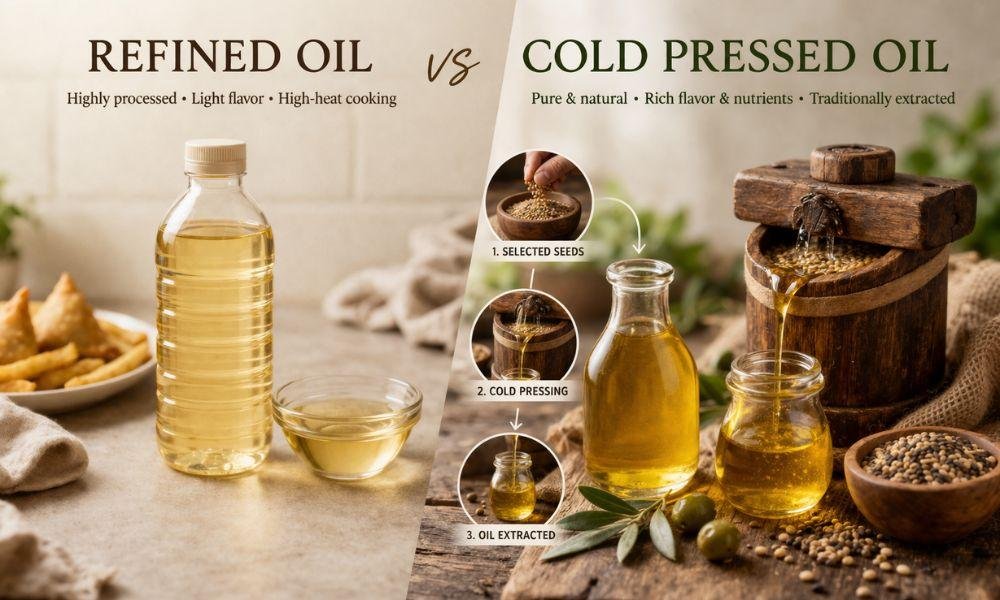
Cold-pressed oil is extracted from seeds, nuts, or fruits primarily through mechanical pressing, with relatively little processing and limited added heat during extraction.
Because it undergoes less processing, cold-pressed oils can retain more of the natural compounds found in the original ingredient.
Depending on the source, they may have a stronger natural aroma, flavor, and color.
Popular cold-pressed oils include:
Cold-pressed groundnut oil
Cold-pressed sesame oil
Cold-pressed coconut oil
Cold-pressed sunflower oil
Cold-pressed mustard oil
Why do people choose cold-pressed oils?
Less processing: They generally undergo fewer processing steps.
Natural flavor: They often retain more of the characteristic taste and aroma of the source.
Natural compounds: Some naturally occurring antioxidants and other minor compounds can remain in greater amounts than in highly refined oils.
But remember: “cold-pressed” doesn't automatically mean “healthy.”
The nutritional quality still depends on the type of oil and its fatty-acid composition.
🧪 What Is Refined Oil?
Refined oil goes through additional processing designed to remove unwanted substances, odors, flavors, colors, and impurities.
Depending on the oil and manufacturing process, refining can involve steps such as degumming, neutralization, bleaching, and deodorization.
This produces an oil that is generally:
Lighter in color
More neutral in taste
Mild in aroma
More consistent
Often more stable during storage
Common refined oils include:
Refined sunflower oil
Refined soybean oil
Refined rice bran oil
Refined canola oil
Refined palmolein oil
Refined oils aren't automatically unhealthy simply because they are refined.
The type of oil, fatty-acid profile, quantity consumed, and cooking practices matter much more than the word “refined” alone.
⚔️ Cold-Pressed vs Refined Oil: What's the Difference?
Here's the quick comparison:
| Feature | Cold-Pressed Oil | Refined Oil |
|---|---|---|
| Processing | Relatively less processed | More extensively processed |
| Flavor | Natural, stronger flavor | Usually neutral |
| Aroma | More noticeable | Usually mild |
| Color | Often retains natural color | Usually lighter |
| Natural compounds | Can retain more | Some are reduced during refining |
| Storage stability | Depends on the oil | Often good |
| Cooking | Depends on the specific oil | Often versatile |
| Price | Often more expensive | Usually more affordable |
❤️ Is Cold-Pressed Oil Healthier Than Refined Oil?
This is where things get interesting.
There isn't a single answer that applies to every oil.
Cold-pressed oils can retain more naturally occurring compounds because they undergo less processing. However, that doesn't mean every cold-pressed oil is automatically a better choice than every refined oil.
For example, different oils have different amounts and types of fatty acids.
So instead of asking:
❌ “Is cold-pressed oil healthy?”
A better question is:
✅ “What type of oil is it, what is its fat composition, and how am I using it?”
That's a much more useful way to think about cooking oils.
🔥 Can You Cook With Cold-Pressed Oil?
Yes—but the suitability depends on the specific oil and cooking method.
Different oils have different smoke points and fatty-acid compositions.
For everyday cooking, consider:
The specific oil you're using
Cooking temperature
Cooking duration
Whether you're frying or sautéing
How often the oil is reused
For prolonged high-temperature cooking and deep frying, repeatedly heating oil should generally be avoided.
🍳 What About Refined Oil for Deep Frying?
Refined oils are commonly used for frying because their processing can improve consistency and storage stability.
However, “refined” does not mean you can heat the oil indefinitely.
Repeatedly heating and reusing cooking oil can cause undesirable chemical changes.
A simple rule:
Use the right oil for the cooking method—and avoid repeatedly reheating the same oil.
🛒 How to Choose a Good Cooking Oil
Don't choose an oil just because the bottle says “cold-pressed,” “natural,” or “refined.”
Look at the bigger picture.
Check these 5 things:
1. What is the source?
Groundnut, sesame, sunflower, mustard, olive, coconut, etc. all have different nutritional profiles.
2. What is the fatty-acid composition?
This is more meaningful than simply looking at whether the oil is refined or cold-pressed.
3. How will you use it?
An oil used for salad dressing doesn't necessarily need to be the same oil you use for deep frying.
4. How much are you using?
Even a good-quality oil contributes calories, so quantity matters.
5. How are you storing it?
Keep cooking oils properly sealed and away from excessive heat and light.
🥄 Is Cold-Pressed Oil Worth the Extra Price?
For some people, yes.
If you prefer the natural taste and less-processed nature of cold-pressed oils, they may be worth choosing.
But you don't need to assume that an expensive cold-pressed oil is automatically superior to a reasonably priced refined oil.
The best choice depends on your overall diet, cooking style, preferences, and budget.
🚨 5 Common Myths About Cooking Oils
Myth 1: “Cold-pressed oil is always healthy.”
Reality: Cold-pressed describes the extraction/processing method. It doesn't automatically make every oil nutritionally superior.
Myth 2: “All refined oils are unhealthy.”
Reality: Refining changes the oil's properties, but the overall nutritional picture depends on the specific oil and how it is consumed.
Myth 3: “Cold-pressed oils cannot be heated.”
Reality: Cooking suitability depends on the particular oil and temperature. Not every cold-pressed oil behaves the same way.
Myth 4: “You can reuse frying oil many times.”
Reality: Repeated heating can cause undesirable changes in oil, so frequent reuse should be avoided.
Myth 5: “The most expensive oil is the healthiest.”
Reality: Price isn't a reliable measure of nutritional quality.
🏆 So, Which Is Better: Cold-Pressed or Refined Oil?
There is no universal winner.
Cold-pressed oils offer the advantage of less processing and potentially greater retention of natural compounds, while refined oils offer neutral flavor, consistency, and often good storage stability.
The most important factors are:
✔ Type of oil
✔ Fatty-acid composition
✔ Cooking method
✔ Quantity consumed
✔ Proper storage
✔ Avoiding repeated heating
Instead of completely eliminating one category, make an informed choice based on how you actually use the oil.
🔍 Frequently Asked Questions
Is cold-pressed oil better than refined oil?
Not necessarily in every situation. Cold-pressed oils are less processed and can retain more natural compounds, but the nutritional quality also depends on the specific oil and its fatty-acid composition.
Which oil is best for everyday cooking?
There is no single best oil for everyone. Choose an oil with a suitable nutritional profile for your diet and cooking method, and use it in moderation.
Can cold-pressed oil be used for frying?
It depends on the specific oil and the cooking temperature. Always consider the oil's characteristics rather than assuming all cold-pressed oils are the same.
Is refined oil safe for cooking?
Refined cooking oils can be used as part of a balanced diet. The type of oil, amount used, cooking method, and frequency of reuse are important considerations.
Should I completely stop using refined oil?
Not necessarily. There's no need to make a blanket decision based only on whether an oil is refined or unrefined.
🧠 Final Takeaway
The next time you stand in front of the cooking-oil section wondering “Cold-pressed or refined?”, don't just look at the biggest health claim on the bottle.
Look beyond the label.
Know the oil. Understand how it is processed. Check how you're going to use it. And most importantly, pay attention to how much you consume.
Because when it comes to cooking oil, the healthiest choice isn't simply about “cold-pressed vs refined”—it's about making an informed choice.
What do you use at home—cold-pressed or refined oil? Let us know in the comments!
📌 Quick Summary
Cold-Pressed Oil
Less processed
Natural flavor and aroma
Can retain more natural compounds
Often more expensive
Cooking suitability depends on the specific oil
Refined Oil
More extensively processed
Neutral taste and aroma
Consistent appearance
Often good storage stability
Commonly used for various cooking applications
Bottom line: Don't judge an oil by the words “cold-pressed” or “refined” alone. Look at the type of oil, its nutritional profile, cooking method, quantity, and overall diet.